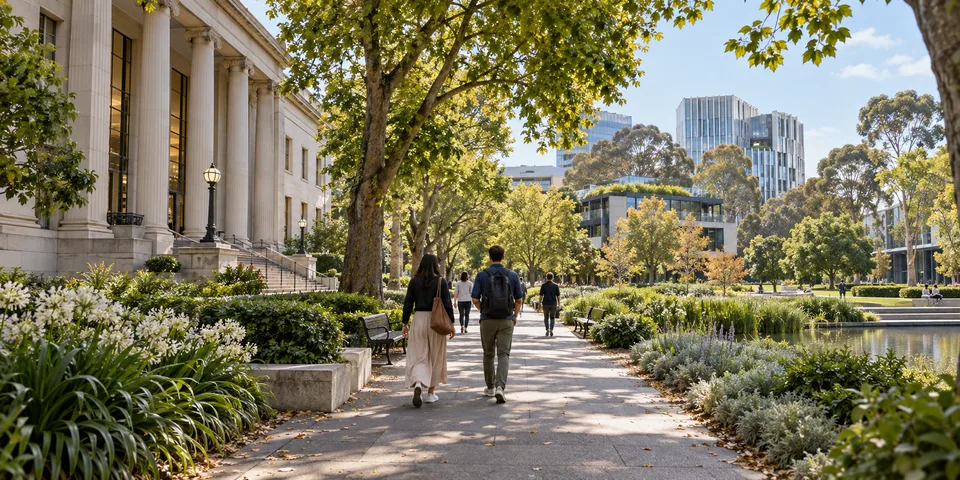
A northern-quarter day on foot
The City of Melbourne’s Culture and Ideas Walk is an approximately five-kilometre, two-hour route through the northern part of the city. It joins libraries, universities, gardens, museums and Lygon Street rather than trying to compress Melbourne’s whole cultural offer into one loop. Think of the published timing as a moving time estimate, not a promise that every stop will be open, free or suited to a long visit. The route becomes more rewarding when you choose two or three places to enter and let the remainder act as a sequence of streets, architecture and public space.
Start at State Library Victoria
The official walk begins at State Library Victoria, on Swanston Street. The City highlights its 1856 origins, reading rooms and exhibition spaces, including the domed La Trobe Reading Room. Begin here with enough room to orient yourself and check current access arrangements before choosing whether to go inside. A library can be the first substantial stop rather than a quick photograph: it gives the route a calm opening and helps avoid the temptation to rush from landmark to landmark. If the building is busy or your time is short, continue the public route rather than forcing a long visit.
Read the route as a set of connected themes
From the library, the route moves through the RMIT area and toward the innovation district, then through sites that connect city institutions, public art, history and university life. The City’s guide points to the portrait of Woi Wurrung ngurungaeta William Barak on Swanston Square and to Standing by Tunnerminnerwait and Maulboyheenner near Melbourne City Baths. These are places to approach with attention rather than as decorative backdrop. The City’s description identifies Barak as an activist, artist and educator, and notes that the memorial honours two Aboriginal men executed in 1842. Read the official guide at the stop if you want the fuller context.
Allow time for gardens and museums
The walk takes in the Royal Exhibition Building and Carlton Gardens before Melbourne Museum and Bunjilaka Aboriginal Cultural Centre. These locations can expand a two-hour route substantially, particularly if you visit museums rather than viewing their grounds from outside. The City also notes Moreton Bay fig trees in Carlton Gardens as a historical meeting place for Aboriginal communities. Treat the garden section as a slower reset between built sites. Museum hours, ticket conditions and exhibition access are separate questions, so consult each institution directly before making it a fixed part of the day.
Use Lygon Street as a pause, not a deadline
The route continues through Argyle Square and Lygon Street, where the City points to the area’s Little Italy identity. This is a sensible place to rest, eat or decide whether the remainder of the route still suits your energy. A walking itinerary does not need to end exactly where a map suggests; it can be shortened after the gardens or resumed after a meal. Avoid turning a café stop into a hard reservation unless you are certain of timing, because museums and streetscape stops naturally vary in length.
Finish with a practical choice
Queen Victoria Market is the final numbered stop in the City’s walk and is a natural place to finish or to leave for another morning, depending on trading conditions and appetite. The City’s page describes it as a place for fresh produce and crafts and notes its long operating history and significance as a former cemetery site. That history deserves more than a passing sentence, so rely on the market’s own current information if you plan a detailed visit. There is no need to complete every route point for the walk to succeed; the useful outcome is a coherent connection between Melbourne’s cultural institutions and neighbourhood life.
Prepare for an urban walk
Wear shoes suited to a five-kilometre city route, carry water and use marked crossings. Check weather and venue hours on the day, especially if gardens, museum interiors or a food stop are central to your plan. The City publishes the walk as self-guided and provides a downloadable guide; printed walk guides are also available from its visitor centres. Use the current map rather than following an old blog route, because public works, venue entries and opening arrangements can change. A flexible two-to-four hour window is more realistic than trying to force every stop into exactly two hours.
Sources
Sources last validated: 14 September 2026.